
Driveway Installation
in Port Orchard, Washington
Everyone judges a new driveway on the day the last load of rock goes down. It looks sharp, it drives smooth, and the job seems finished.
The real test comes in February. That is when a driveway built on unprepared ground starts to rut, pump mud up through the surface and develop the soft spots that swallow a tire. We build new driveways across Port Orchard and the rest of Kitsap County for the second test, not the first one.
★★★★★
"Straight Up Excavation did a great job on our driveway. They were on time and did all that was expected. Very happy with the clean gravel they put down as requested. Makes for less mud opportunities in the rainy season! Definitely appreciate the compacting!"
Syndi Oglesby, Google Review
★★★★★
"Came out to give us an estimate, had us booked for the following week. Showed up on time, did GREAT work with communication every step of the process. Driveway looked fantastic, drained well, and was super smooth. We will be using them again for sure."
Martin Cromwell, Google Review
★★★★★
"Doug and his crew performed a total transformation on my front yard and added a gravel driveway. The crew was very efficient and I was pleased with the result."
David McCumber, Google Review
Why Gravel Is Usually the Right Call Here
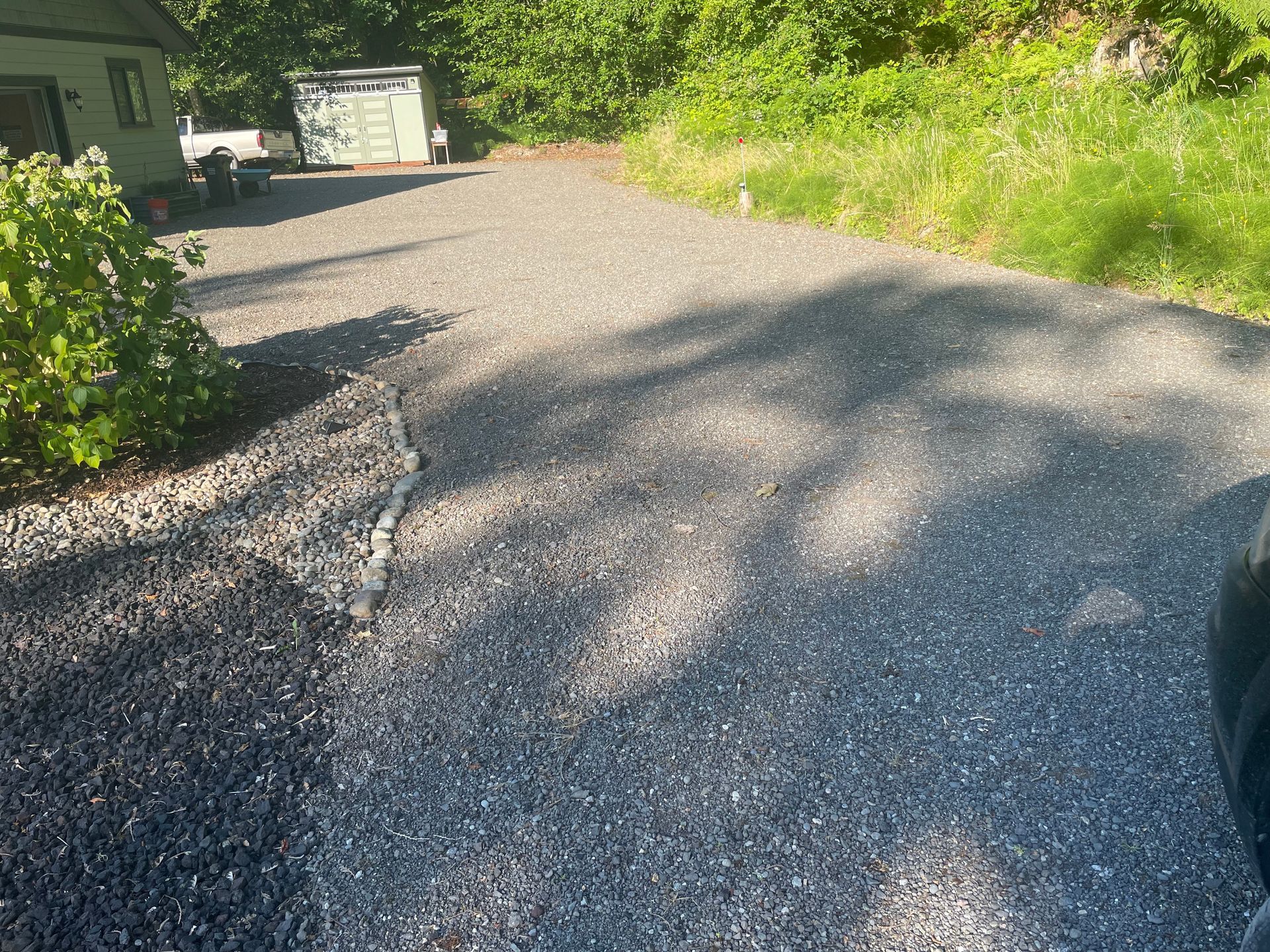
Asphalt and concrete have their place. On most rural and semi rural lots around Kitsap County, gravel beats both, and not only on price.
What makes it the practical choice on a wet, sloping lot?
Gravel drains. Our ground gets saturated for months at a time, and a permeable surface lets water pass through instead of sheeting off the edges and cutting channels down the sides. Gravel also moves with the ground. Soils here heave and settle through a wet winter, and a slab cracks where a rock driveway just shifts and gets regraded. When a gravel driveway does get tired, you top it up. When a concrete one fails, you demolish it.
There is one more thing that matters on long rural approaches. A gravel driveway can be repaired in sections. Nobody has to shut down access to the property for a week while something cures.
What Actually Goes Under a Driveway That Lasts
Here is the part that decides whether your driveway is still good in ten years, and it happens before any of the pretty rock arrives.
Strip the topsoil.
Organic material rots, compresses and turns into a sponge. It has to come out, which usually means removing the top 8 to 12 inches until we reach firm native soil.
Fix the subgrade.
If what is underneath is soft clay or holds water, more rock on top will not save it. Depending on what we find, that means over excavating deeper, bringing in structural fill, or laying geotextile fabric so the base rock and the mud below it never mix. Fabric is cheap. Rebuilding a driveway that has pumped its base into the clay is not.
Build the base in compacted lifts.
Larger base rock goes down first and gets compacted in layers rather than dumped at full depth. Depth depends on soil and on what will drive across it. A family car and a loaded gravel truck are not the same load.
Top course, then compact again.
The final layer is the one you drive on and the one you see.
Set the crown and the drainage.
The surface needs a slight crown or cross slope so water runs off to the sides, and the sides need somewhere to send it. On sloped approaches that often means a ditch line or culvert, which is
drainage work as much as driveway work.
Why go to that trouble when a load of rock spread over the existing ground looks the same on day one?
Because in six months it will not.
Choosing the Right Rock
Clients often ask for a specific rock by name, usually because a neighbor used it. Rock choice matters, but it matters differently depending on which layer you are talking about.
For the base you want angular, well graded material with fines in it, so the pieces lock together under compaction. For the driving surface, crushed rock with fines compacts into a firm surface that sheds water. Round, washed rock looks beautiful in a photograph and migrates under tires, which is why it belongs in a drain trench and not on a driveway you use daily.
The other question is whether you want black basalt or a lighter quarry rock. That one is genuinely about looks, and we will bring you both. Our
gravel driveway cost guide for Kitsap County walks through the material options and what each does to the number.
What a New Driveway Costs
Length and width are the obvious drivers. Underneath them sit the factors that actually swing a quote.
How much material has to come off the site, and where does it go? What is the subgrade made of once we open it up? Is there a slope to cut into, trees or stumps to clear first, a culvert to set at the road, or an old surface to demolish? Can a truck back up the approach, or does every load have to be shuttled in with smaller equipment?
That is why we walk the site before quoting. A number over the phone would be a guess, and guesses get corrected later at your expense. Every crew we send out is licensed and insured, we price the job before we start it, and we back the work with a satisfaction guarantee.
If your driveway already exists and the issue is that it is too narrow rather than too worn, that is a different job with a different page. Have a look at
driveway extensions and widening instead.
Keeping It Right After We Leave
A well built gravel driveway is low maintenance, not no maintenance. Expect to have it graded every couple of years, more often on a steep approach or a long rural run where rain moves material downhill.
Watch for three signs. Water standing anywhere on the surface means the crown has flattened. Ruts forming in the same tracks mean the surface course is thinning. Vegetation creeping in from the edges means the driveway is losing its width, slowly, every year.
Catching those early keeps the fix in the regrade and top up category. Left alone for five years, they turn into a rebuild. We handle ongoing
driveway maintenance for a lot of the properties we originally built for, and there is more on the heavier work at our
driveway and roadway excavation page.
Frequently Asked Questions
Ready to Get Started?
We are family-owned and based right here in Port Orchard, working across Kitsap County, Mason County and Gig Harbor.
Most of our work arrives by word of mouth, which is a good discipline. It means the driveway has to still look right when the neighbor asks who did it.
Planning a new gravel driveway or an RV pad?
Call Straight Up Excavation and Drainage at 360-337-9051 for a driveway installation quote in Port Orchard.