

Retaining Wall Contractors
in Port Orchard, Washington
A retaining wall has one job. It holds back ground that wants to move. Everything else about it, the color of the rock, the way it squares up with a patio, the height you picked so the kids get a flat lawn, sits on top of that single job.
Around Port Orchard, ground wants to move quite a bit. We build walls across Kitsap County, Mason County and Gig Harbor for people who have run out of usable yard, and for people who watched a bank slump after a wet November and worked out that it was not going to fix itself.
Get a retaining wall estimate for your Port Orchard property
★★★★★
"Doug and his crew did an amazing job with a rebuild of my collapsing retaining wall and fence, as well as an asphalt drive way removal. They worked hard to get the job done, and Doug went above and beyond my expectations. My family and I finally have a reason to love our back yard."
Christina Sanseverino, Google Review
★★★★★
"Doug did a great job repairing the rock wall along the side of our home foundation and it looks better than new. Great attitude and work ethic from everyone at this company, I would highly recommend them."
Bubba Zinetti, Google Review
★★★★★
"Smoothed and leveled a 50x75 foot section of the yard. It had some tricky bits due to trees/Retaining wall, but with professionalism and care made it look great."
E G, Google Review
Why Retaining Walls Fail Around Port Orchard
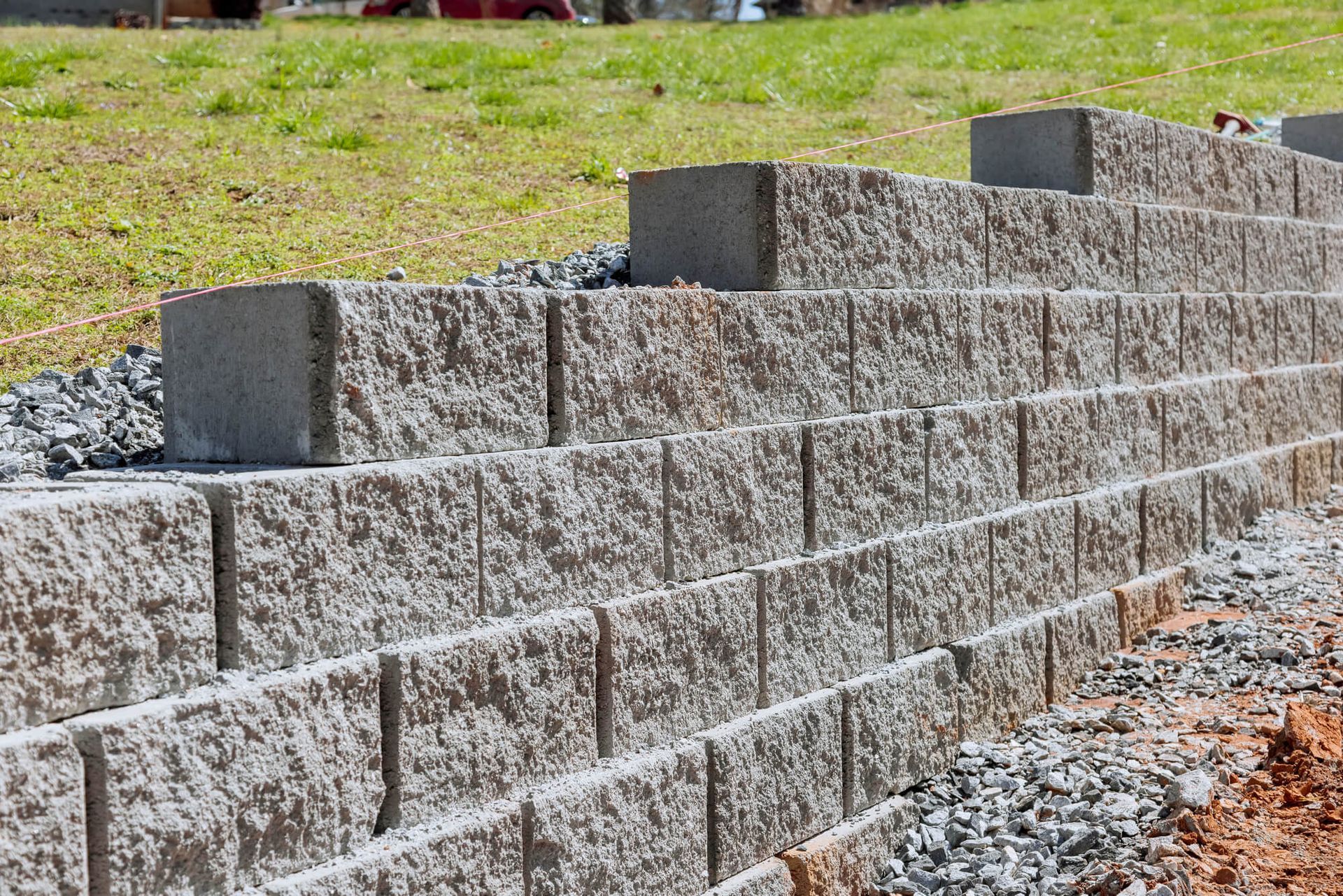
Most of the failed walls we get called out to look at were not built badly on the surface. The stone is stacked fine. The line is straight. What went wrong is behind them, where nobody can see.
Our soils here are a mix of glacial till, clay lenses and pockets of sand, and they sit under one of the wetter climates in the country. Water soaks in through autumn, hits a layer it cannot pass through, and then travels sideways until something stops it. If the thing that stops it is your wall, the wall is now holding back saturated soil instead of damp soil. Saturated soil is far heavier and it pushes with real force.
So how do you tell a wall that is settling from a wall that is failing?
Settling is even and it stops. Failure leans, bulges in the middle, opens gaps at the joints, or starts pushing the top course out over the toe. If you can see daylight through a joint that used to be tight, or the ground behind the wall has dropped away, the wall is losing.
The fix is almost never more rock. It is drainage, base preparation and compaction. That is the part of the work nobody photographs.
Retaining Wall Types We Build and When Each One Fits
Rock and boulder walls
are the workhorse on rural Kitsap properties. They flex slightly with the ground instead of cracking, they handle irregular heights well, and they look at home against trees. For a bank behind a house or along a driveway cut, this is usually what we recommend.
Segmental block walls
give you clean geometry, so they suit terraced yards, planters and anywhere the wall is part of the view from the deck. With geogrid tied back into the hillside they carry serious height.
Timber walls
still make sense for lower garden terracing where budget matters and the wall is not holding anything structural.
Poured concrete
goes in where a wall is doing double duty, holding ground and carrying load, which brings it closer to the
foundation excavation work we do for new builds.
The choice is driven by height, what sits above and below the wall, how much room there is to dig back into the slope, and what the soil is actually made of once we open it up. We would rather tell you a rock wall suits your bank better than sell you the more expensive option.
How We Build a Wall That Stays Put
Every wall we put in follows the same sequence, whether it is 30 feet of garden terracing or a long run holding a driveway bank.
1. Dig and
inspect.
We cut back to firm native soil and see what is really there. Clay changes the plan. So does a spring nobody knew about.
2. Base trench and
compacted rock.
The base course sits on compacted crushed rock, and roughly the bottom tenth of the wall height goes below finished grade. A wall that starts at the surface has nothing to lean on.
3. Build in lifts,
compact behind each one.
Loose backfill settles later and takes the wall with it.
4. Drainage rock and perforated pipe behind the full length.
Wrapped in filter fabric so silt does not clog it, and daylighted somewhere sensible rather than into the neighbor's yard.
5. Backfill, grade and tie into the surrounding ground
so surface water runs past the wall instead of over it. This often means a bit of
land grading beyond the wall itself.
Step four is the one that separates a wall you forget about from a wall you rebuild in eight years.
What a Retaining Wall Costs in Kitsap County
Nobody can price a wall from a photo, and we will not pretend otherwise. What we can tell you is what moves the number.
Height is the biggest factor, and not in a straight line. A four foot wall is not twice a two foot wall, because past roughly four feet from the bottom of the footing you are usually into engineered design, deeper base preparation and geogrid. Access is the second factor. If the machine can reach the work, the job is efficient. If everything has to come through a side gate by hand, the labor changes completely.
After that: the material you choose, how much spoil has to leave the site, whether there is an old failing wall to demolish first, and what we find when we dig. Permits matter too. We confirm the current thresholds with Kitsap County before quoting rather than guessing, and our guide to excavation permits in Kitsap County covers what homeowners usually need to know.
We quote after we walk the site. Every crew that shows up is
licensed and insured, and we stand behind the work with
a satisfaction guarantee.
Maintenance, Property Value and Knowing When to Act
A properly drained wall asks very little of you. Keep the drainage outlet clear, keep large roots off it, and walk the line once a year after the first heavy rain to check for bulges or new gaps. That is the whole maintenance list.
Is a wall worth what it costs?
On a sloped lot, usually yes, because it converts ground you cannot use into ground you can. A terraced yard is a yard. A 30 degree bank is scenery. The wall also protects what is uphill and downhill of it, which is the part people undervalue until a slope lets go near a foundation.
If your wall is already leaning, the honest advice is to move sooner. A wall that has started to move keeps moving, and a rebuild after a collapse costs more than a rebuild before one, because the collapse takes the fence, the plants and a chunk of yard with it.
Frequently Asked Questions
Talk to Us About Your Slope
We are a family-owned outfit working out of Port Orchard, and most of our work comes from neighbors of people we have already built for. If you want a look at the rest of what we do, our excavation services and site preparation pages cover the bigger jobs, and drainage solutions covers the water problems that often show up alongside a failing wall.
Got a bank that is moving, or a slope you want to turn into usable yard?
.Call Straight Up Excavation and Drainage at 360-337-9051 for a retaining wall estimate in Port Orchard.